
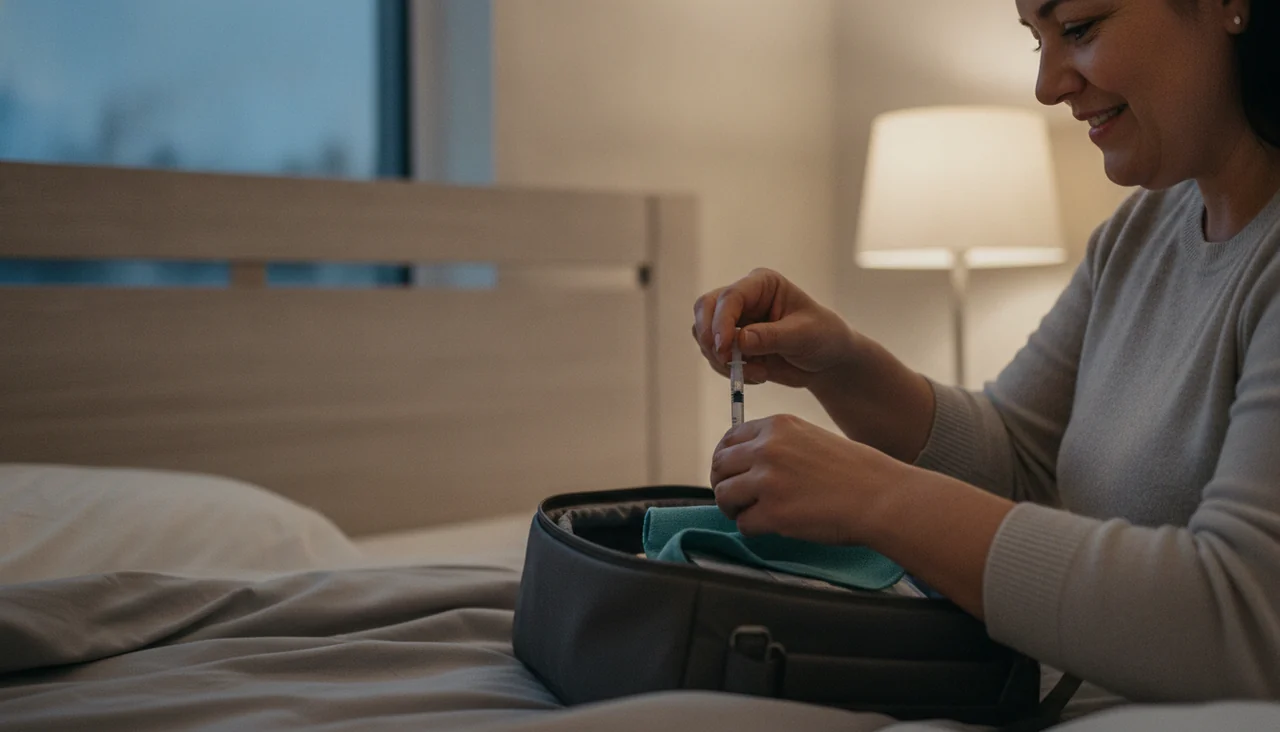
45 or 90 degrees: what angle for a subcutaneous injection?
A small angle question with one simple driver: how far the needle needs to travel.
TL;DR
- Subcutaneous shots use a 45-degree or 90-degree injection angle.
- Needle length is the main factor that decides which to use.
- Short needles go at 90 degrees; longer needles often use 45.
What injection angle to use
The right injection angle for a subcutaneous shot is either 45 or 90 degrees, and the deciding factor is needle length. A subcutaneous injection (in plain English: a shot into the fat layer just under the skin) needs to land in fat, not muscle. Think of the fat layer as a cushion you are aiming for. A short needle can go straight down and still stay in the cushion. A longer needle pointed straight down might punch through it, so you tilt.
How it works
The needle has to stop inside the fat, and the angle changes how deep it reaches. At 90 degrees, the needle travels its full length straight in. At 45 degrees, the same needle reaches less deep because it enters at a slant. Picture pushing a straw into a sandwich. Straight down goes deeper. Angled goes shallower. So short insulin-style needles usually work at 90 degrees, while longer needles or very lean sites often use 45 degrees to stay in the cushion.
Who asks about it
People ask before a first self-injection, unsure which angle the instructions mean. The real worry is going too deep or hitting muscle. Matching the angle to the needle solves most of that concern.
What the research says
Standard nursing guidance describes subcutaneous injections given at a 45-to-90-degree angle depending on needle length and the amount of subcutaneous tissue, per the US National Library of Medicine's MedlinePlus (2024). Clinical references on the NCBI Bookshelf note that a pinched skin fold can help keep an angled needle in the fat layer (NCBI Bookshelf, 2023). Exact technique varies with the device and site.
What to know before considering it
Angle is only one part of good technique. Site rotation, clean skin, and the correct needle also matter. Any peptide injection requires a licensed clinician who prescribes it and confirms your device, dose, and method. Follow the instructions that come with your specific needle.
The Halftime POV
We spend time on the small stuff because the small stuff is where confidence comes from. Knowing why the angle changes turns a scary first shot into a simple, repeatable habit. Clear technique makes the whole protocol feel manageable.
Related reading:
- injection technique primer
- science subcutaneous injection fat layer
- how to give first peptide injection
FAQ
Q: what injection angle for subcutaneous shots A: A subcutaneous injection uses either a 45-degree or a 90-degree angle. The choice mostly depends on needle length and how much fat sits under the skin at the injection site.
Q: should i inject at 45 or 90 degrees A: Short insulin-style needles are usually given at 90 degrees, while longer needles or very lean sites often use 45 degrees. Your clinician should confirm the angle for your specific needle.
Q: does needle length change the injection angle A: Yes. A longer needle at 90 degrees can reach past the fat into muscle, so a shallower 45-degree angle keeps the medicine in the fat layer where it belongs.
Disclaimer
This article is educational and is not medical advice. Compounded medications are not FDA-approved. Clinical outcomes depend on individual factors and require physician evaluation. Results vary.
Get started
We share what we learn along the way — the research, the regulations, the real-world trade-offs. Get started with Halftime Health.
Sources
Frequently asked questions
what injection angle for subcutaneous shots
A subcutaneous injection uses either a 45-degree or a 90-degree angle. The choice mostly depends on needle length and how much fat sits under the skin at the injection site.
should i inject at 45 or 90 degrees
Short insulin-style needles are usually given at 90 degrees, while longer needles or very lean sites often use 45 degrees. Your clinician should confirm the angle for your specific needle.
does needle length change the injection angle
Yes. A longer needle at 90 degrees can reach past the fat into muscle, so a shallower 45-degree angle keeps the medicine in the fat layer where it belongs.
Keep reading


A licensed physician can build a protocol from your own labs.
Membership from $39/mo, or $390 for the year, including your onboarding panel. Each protocol is its own monthly subscription.