
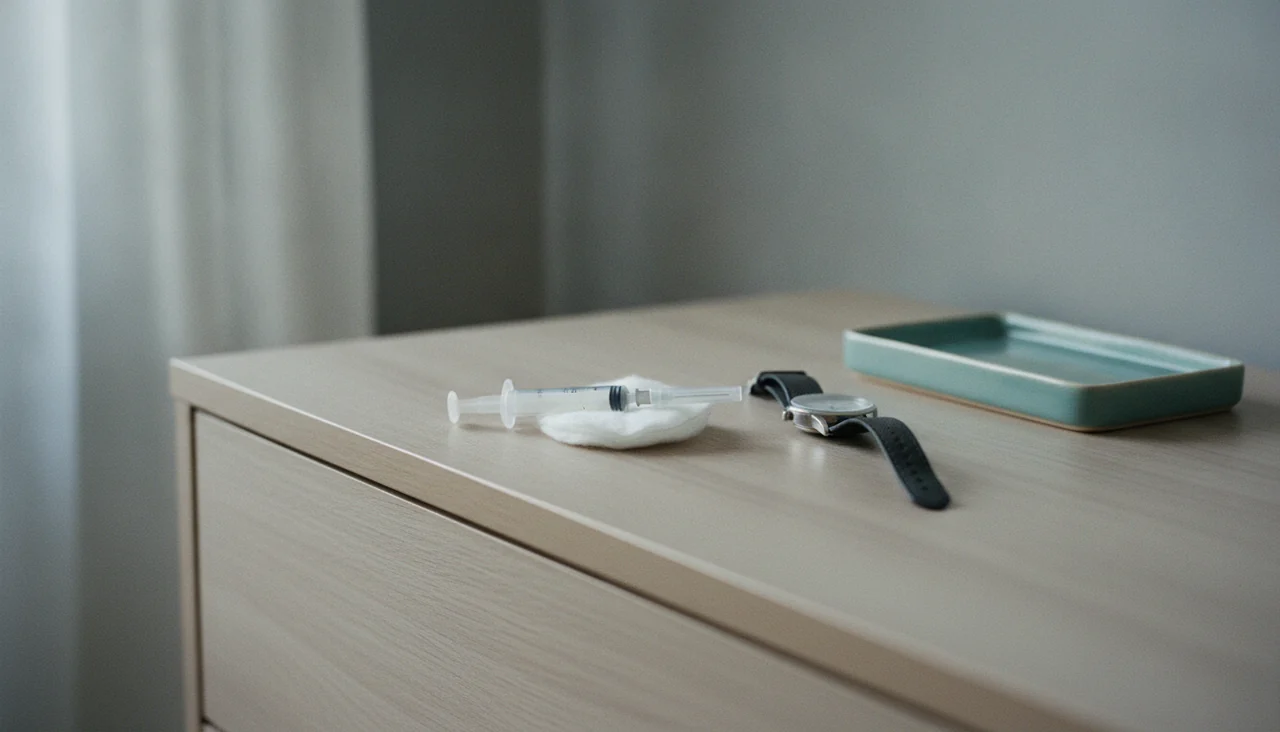
How long to hold the needle in after an injection
A small pause, for a simple physical reason.
TL;DR
- Nursing references teach a pause of roughly ten seconds before withdrawing the needle.
- The pause gives the fluid time to spread into the fatty layer instead of back out.
- Withdraw at the same angle you inserted, then apply gentle pressure.
Why you hold the needle in place
You hold the needle in place so the medication has time to disperse before the path out reopens. The needle track is a narrow tunnel. If you pull straight after pressing the plunger, some fluid can follow the tunnel back to the surface. Nursing skills references from the NIH's NCBI Bookshelf describe leaving the needle in place for about ten seconds after injecting, then removing it with a smooth, steady motion (NCBI Bookshelf, 2023).
How it works
Picture pressing your thumb into wet sand. Lift it immediately and water fills the dent. Wait a moment and the sand settles. Subcutaneous tissue behaves a little like that. The injected volume needs a few seconds to move sideways into the fat layer, where blood vessels will slowly pick it up. Withdrawing at the same angle you inserted keeps the track narrow, which is why references pair the pause with a matched-angle withdrawal (NCBI Bookshelf, 2023).
Who asks about it
People ask after seeing a bead of liquid at the site and worrying they lost part of a dose. It is one of the most common first-week questions in self-injection. The fix is almost always timing and angle, not technique overhaul.
What the research says
Published nursing and patient-education references converge on the same technique. The NIH's Nursing Skills text describes a ten-second pause and a smooth, steady withdrawal at the insertion angle (NCBI Bookshelf, 2023). MedlinePlus patient instructions for subcutaneous injections describe the same sequence in plainer terms (MedlinePlus, 2023). These are technique standards drawn from clinical practice rather than results from a randomized trial. There is no strong evidence that a longer pause improves anything, and none of this replaces the specific instructions attached to your medication.
What to know before considering it
Patient instructions from MedlinePlus advise applying gentle pressure with clean gauze after withdrawal rather than rubbing the site (MedlinePlus, 2023). Rotate sites so tissue can recover between injections. If leakage happens every time, or if you see swelling, spreading redness or persistent pain, contact your clinician rather than adjusting your own dose. Never make up a suspected partial dose on your own.
The Halftime POV
Self-injection is mostly a set of very small habits, and this is one of the smallest. Getting it right removes a recurring worry from the first few weeks. We would rather answer the ten-second question plainly than let someone quietly second-guess every dose.
Related reading:
FAQ
Q: how long should you hold the needle after injecting A: Nursing references commonly teach a pause of about ten seconds after the plunger bottoms out, then a smooth withdrawal at the same angle the needle went in.
Q: why does liquid leak out after an injection A: Usually because the needle came out before the fluid had time to spread into the fatty layer. A brief pause and a straight withdrawal reduce how often that happens.
Q: should you rub the injection site afterwards A: General patient instructions advise gentle pressure rather than rubbing. Rubbing can irritate the tissue, and your clinician's instructions for a specific medication always take priority.
Disclaimer
This article is educational and is not medical advice. Compounded medications are not FDA-approved. Clinical outcomes depend on individual factors and require physician evaluation. Results vary.
Get started
We share what we learn along the way — the research, the regulations, the real-world trade-offs. Get started with Halftime Health.
Sources
Frequently asked questions
how long should you hold the needle after injecting
Nursing references commonly teach a pause of about ten seconds after the plunger bottoms out, then a smooth withdrawal at the same angle the needle went in.
why does liquid leak out after an injection
Usually because the needle came out before the fluid had time to spread into the fatty layer. A brief pause and a straight withdrawal reduce how often that happens.
should you rub the injection site afterwards
General patient instructions advise gentle pressure rather than rubbing. Rubbing can irritate the tissue, and your clinician's instructions for a specific medication always take priority.
Keep reading

A licensed physician can build a protocol from your own labs.
Membership from $39/mo, or $390 for the year, including your onboarding panel. Each protocol is its own monthly subscription.