
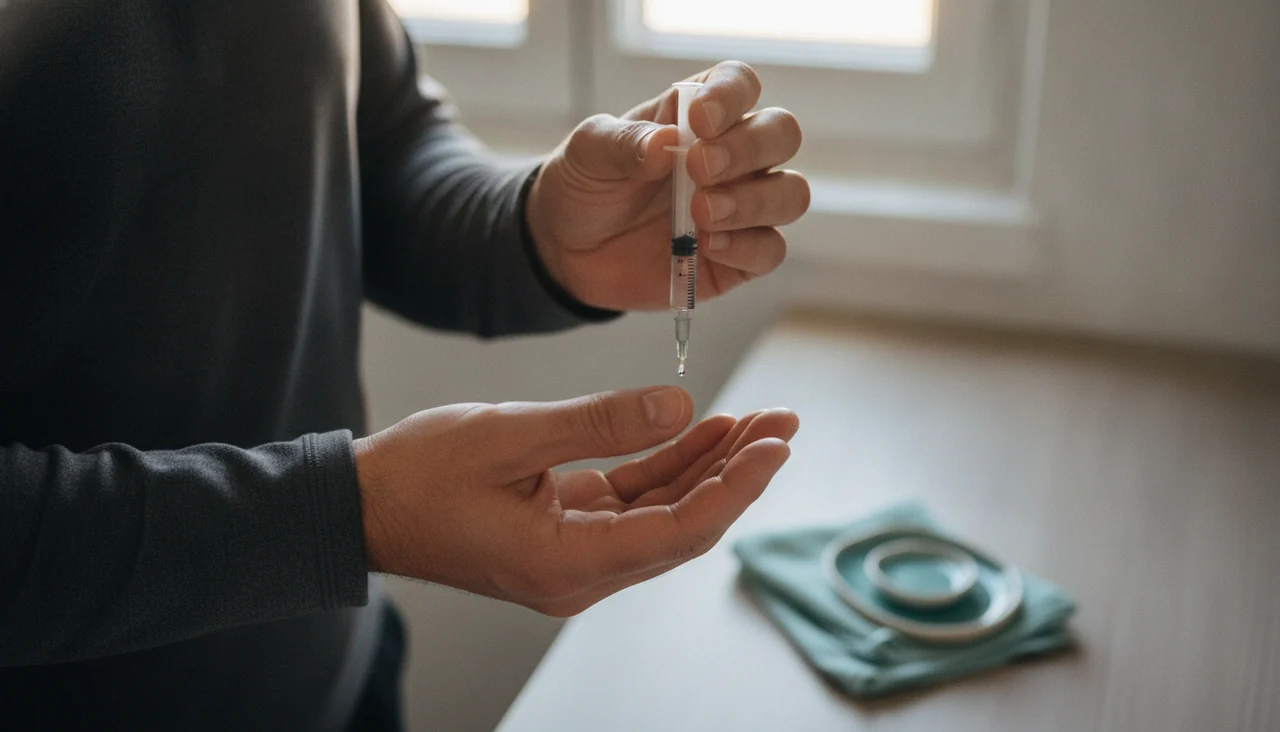
Syringe dead space, explained
Syringe dead space is the small pocket of liquid trapped in the hub and needle after the plunger bottoms out. It's invisible on the barrel's markings, but real.
TL;DR
- Syringe dead space is the small volume of liquid left in the needle and hub after the plunger bottoms out.
- Low dead-space syringes with a fixed needle trap far less residual fluid than syringes with a detachable needle.
- That leftover volume doesn't shrink with the dose, so it matters more for small peptide draws than large ones.
What is syringe dead space, really?
Syringe dead space (in plain English: leftover liquid trapped after a full plunger push) sits between the plunger tip and the needle opening. Every syringe and needle combination has some, because a small void remains at full depression. The World Health Organization, or WHO, uses this definition in its 2012 guidance on safer injecting equipment (WHO, 2012).
How syringe dead space works
Picture a garden hose right after you shut off the tap: a little water still sits inside, even though the flow has stopped. A syringe behaves the same way. Fixed-needle designs, where the needle is permanently joined to the barrel, close that gap almost completely. Detachable-needle syringes leave a wider gap, trapping more liquid. WHO reports that a low dead-space syringe (in plain English: one built to shrink this leftover volume) can hold up to 100-fold less residual fluid than a standard design (WHO, 2012).
Who asks about syringe dead space
People hit this question when a reconstituted vial runs dry sooner than expected, or when a dosing guide assumes every microliter drawn gets delivered. It's a live public-health topic too: needle and syringe programs distribute low dead-space syringes to cut disease transmission when equipment is shared (WHO, 2012).
What the research says
The Food and Drug Administration, or FDA, regards dead space as a measurable engineering property, not a guess. FDA's 2019 clearance review of the BD Insulin Syringe confirmed dead-space testing under ISO 8537, the insulin syringe standard (FDA, 2019). The Centers for Disease Control and Prevention, or CDC, made a related point during COVID-19 vaccine rollout. Without low dead-volume equipment, a vial yielded fewer usable doses than its label promised (CDC, 2022).
What to know before considering syringe dead space
Dead space is a hardware property, not a dosing instruction, and this article isn't one either. Reconstitution math shouldn't assume 100 percent of a drawn volume reaches the injection site. Fixed-needle, low dead-space syringes, the kind typically used for insulin, leave less behind than detachable-needle syringes. Any specific reconstitution or dosing plan belongs with a licensed clinician.
The Halftime POV
We think small mechanical details like this deserve plain explanations, not jargon. A syringe's dead space won't change how a protocol gets prescribed, but understanding it explains why careful technique and the right equipment matter.
Related reading:
- Insulin syringe guide for peptides
- Needle gauge guide for peptide injections
- Reconstitution walkthrough, step by step
- Air bubbles in a peptide syringe
- Injection technique primer
FAQ
Q: what is syringe dead space A: Syringe dead space is the small volume of liquid that stays trapped in the needle and hub after the plunger is fully pressed down. It exists in every syringe and needle combination because a small void always remains at full depression. The World Health Organization defines it this way in its 2012 guidance on safer injecting equipment (WHO, 2012).
Q: why do low dead space syringes matter for peptide injections A: Low dead-space syringes matter for peptide injections because the leftover volume in a syringe doesn't shrink along with a smaller dose. A few microliters of dead space is a rounding error in a 1 mL draw but a meaningful share of a very small peptide dose. The World Health Organization reports that fixed-needle, low dead-space syringes retain up to 100-fold less residual fluid than standard designs (WHO, 2012).
Q: how much liquid does syringe dead space waste A: The exact amount varies by needle gauge, length, and whether the needle is fixed or detachable. Regulators test it directly: FDA's 2019 clearance review of the BD Insulin Syringe confirmed dead-space testing under ISO 8537, the insulin syringe standard (FDA, 2019). That is one reason reconstitution math should not assume every drawn microliter is delivered.
Q: are insulin syringes considered low dead space syringes A: Yes, in general. One-piece insulin-type syringes with a fixed needle are the design most associated with low dead space, because there's no detachable hub to trap extra fluid. The World Health Organization specifically recommends fixed low dead-space insulin syringes for needle and syringe programs (WHO, 2012).
Disclaimer
This article is educational and is not medical advice. Compounded medications are not FDA-approved. Clinical outcomes depend on individual factors and require physician evaluation. Results vary.
Get started
We share what we learn along the way — the research, the regulations, the real-world trade-offs. Get started with Halftime Health.
Sources
- Guidance on Prevention of Viral Hepatitis B and C Among People Who Inject Drugs — World Health Organization, NCBI Bookshelf, 2012
- 510(k) Clearance K190054, BD Insulin Syringe — FDA, 2019
- Identifying, Disposing, and Reporting COVID-19 Vaccine Wastage — CDC, 2022
Frequently asked questions
what is syringe dead space
Syringe dead space is the small volume of liquid that stays trapped in the needle and hub after the plunger is fully pressed down. It exists in every syringe and needle combination because a small void always remains at full depression. The World Health Organization defines it this way in its 2012 guidance on safer injecting equipment (WHO, 2012).
why do low dead space syringes matter for peptide injections
Low dead-space syringes matter for peptide injections because the leftover volume in a syringe doesn't shrink along with a smaller dose. A few microliters of dead space is a rounding error in a 1 mL draw but a meaningful share of a very small peptide dose. The World Health Organization reports that fixed-needle, low dead-space syringes retain up to 100-fold less residual fluid than standard designs (WHO, 2012).
how much liquid does syringe dead space waste
The exact amount varies by needle gauge, length, and whether the needle is fixed or detachable. Regulators test it directly: FDA's 2019 clearance review of the BD Insulin Syringe confirmed dead-space testing under ISO 8537, the insulin syringe standard (FDA, 2019). That is one reason reconstitution math should not assume every drawn microliter is delivered.
are insulin syringes considered low dead space syringes
Yes, in general. One-piece insulin-type syringes with a fixed needle are the design most associated with low dead space, because there's no detachable hub to trap extra fluid. The World Health Organization specifically recommends fixed low dead-space insulin syringes for needle and syringe programs (WHO, 2012).
Keep reading



A licensed physician can build a protocol from your own labs.
Membership from $39/mo, or $390 for the year, including your onboarding panel. Each protocol is its own monthly subscription.