
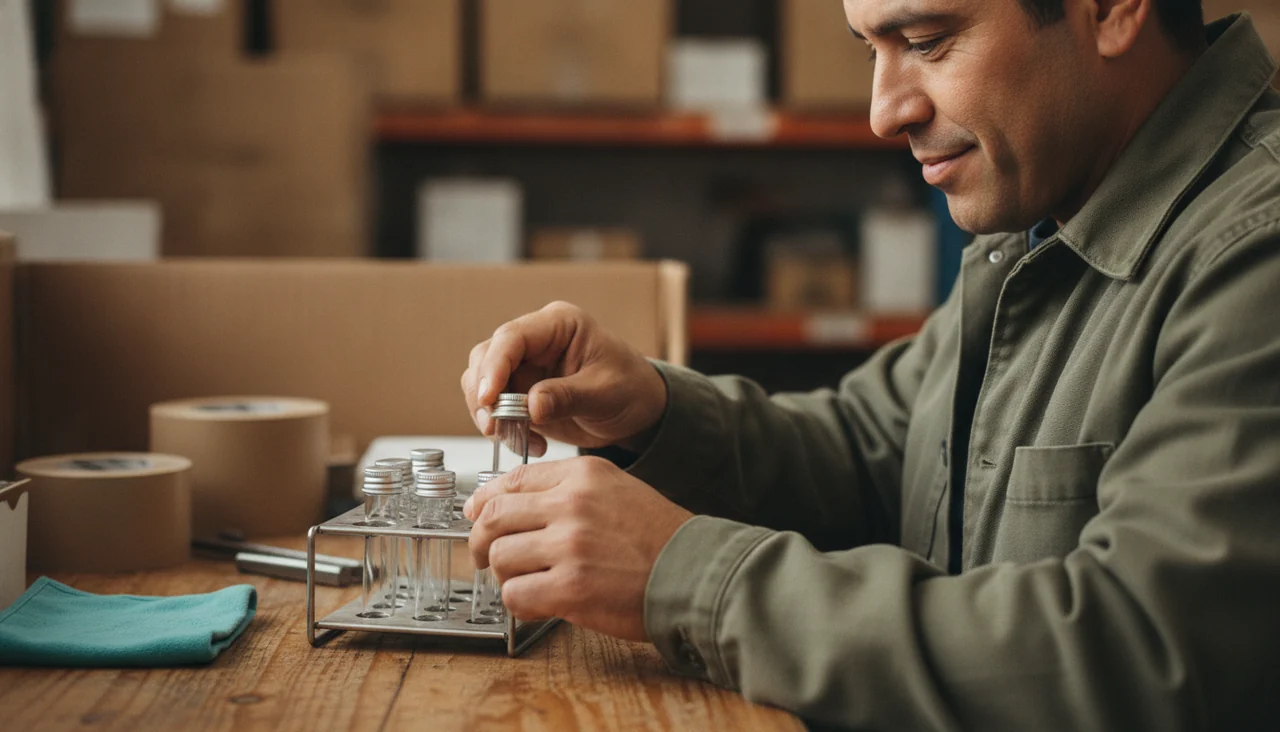
Residual solvent testing: the leftover chemicals a lab checks for
A certificate of analysis lists residual solvents because a compounding pharmacy has to prove the leftover manufacturing chemicals fall under a published safety limit, not just claim it.
TL;DR
- Residual solvent testing checks for organic solvents left over from making a peptide, like acetonitrile, methanol, or trifluoroacetic acid.
- USP General Chapter 467 sorts solvents into three toxicity classes, each with its own allowed limit.
- Gas chromatography is the standard tool used to measure them, and results land on the certificate of analysis.
What is residual solvent testing?
Residual solvent testing is how a lab checks a finished peptide for small amounts of organic solvents (in plain English: carbon-based liquid chemicals used to dissolve or purify things) left over from manufacturing. Peptide synthesis commonly uses solvents like acetonitrile, methanol, and trifluoroacetic acid, or TFA. Manufacturing cannot remove every trace of these chemicals. Testing measures what is left against published safety limits before a batch ships (FDA/ICH, 1997).
How residual solvent testing works
Think of checking laundry for leftover detergent residue. You cannot see it, but a rinse test can detect it. Residual solvent testing works similarly, using gas chromatography (GC), an instrument that separates chemicals as they travel through a heated tube and measures each one as it exits. A sample is warmed until leftover solvent turns to vapor, and the GC identifies and quantifies each compound, compared against USP General Chapter 467 limits (Acta Poloniae Pharmaceutica, 2010).
Who asks about residual solvent testing
People usually ask about residual solvent testing after spotting solvent names on a certificate of analysis they do not recognize, like acetonitrile or TFA. The question is whether those chemicals are dangerous leftovers or expected byproducts. Almost always, it is the latter, and the certificate exists to prove the amount stayed under the limit.
What USP General Chapter 467 actually sets as limits
USP General Chapter 467 sorts residual solvents into three classes by toxicity. Class 1 solvents are known or suspected human hazards and should be avoided. Class 2 solvents are limited to specific concentrations from toxicology data. Class 3 solvents carry lower risk and are accepted up to 50 milligrams per day (FDA/ICH, 1997). Acetonitrile, common in peptide purification, falls into Class 2.
What to know before reading a certificate of analysis
A residual solvent result should show a measured number next to the allowed limit for that solvent's class, not just a pass or fail. Ask a pharmacy which solvent classes were tested for a given peptide, and whether results are batch-specific. A licensed pharmacist can explain what each result actually means.
The Halftime POV
We think a certificate of analysis should be something a member can actually read, not file away. Residual solvent limits exist because a rinse step, however good, is never perfect. Halftime Health sees that paperwork as worth explaining, not hiding behind jargon.
Related reading:
- The certificate of analysis: how to read a peptide pharmacy's quality paperwork.
- API standards: what goes into a compounded peptide.
- Stability-indicating assay: the test that proves a peptide is still intact.
- Forced degradation testing: breaking a drug on purpose.
FAQ
Q: what is residual solvent testing A: Residual solvent testing checks a finished drug or peptide for small amounts of organic solvents left over from manufacturing, like acetonitrile, methanol, or trifluoroacetic acid. These solvents help dissolve, purify, or separate the peptide during production, but practical manufacturing cannot remove every trace. The test measures what remains against published safety limits (FDA/ICH, 1997).
Q: why does a certificate of analysis list residual solvents A: A certificate of analysis lists residual solvents because it is the lab's documented proof that a specific batch was actually tested and met the required limits. It is not a formality. It shows the measured amount of each solvent tested, compared against the limit for that solvent's toxicity class, batch by batch.
Q: what are usp class 1 2 and 3 residual solvents A: USP General Chapter 467 sorts residual solvents into three classes by toxicity. Class 1 solvents should be avoided because of known or suspected serious harm. Class 2 solvents are limited to specific low levels. Class 3 solvents carry lower risk and are allowed up to 50 milligrams per day without extra justification (FDA/ICH, 1997).
Q: how is residual solvent testing performed A: Residual solvent testing is usually performed with gas chromatography (GC), an instrument that separates and measures individual chemicals as they travel through a heated tube. A small sample is heated until leftover solvents turn to vapor, and the GC identifies and quantifies each one against a known reference (Acta Poloniae Pharmaceutica, 2010).
Disclaimer
This article is educational and is not medical advice. Compounded medications are not FDA-approved. Clinical outcomes depend on individual factors and require physician evaluation. Results vary.
Get started
We share what we learn along the way — the research, the regulations, the real-world trade-offs. Get started with Halftime Health.
Sources
- Guidance for Industry: Q3C Impurities — Residual Solvents — FDA/ICH, 1997
- Analytical Methods for Residual Solvents Determination in Pharmaceutical Products — Acta Poloniae Pharmaceutica, 2010
Frequently asked questions
what is residual solvent testing
Residual solvent testing checks a finished drug or peptide for small amounts of organic solvents left over from manufacturing, like acetonitrile, methanol, or trifluoroacetic acid. These solvents help dissolve, purify, or separate the peptide during production, but practical manufacturing cannot remove every trace. The test measures what remains against published safety limits (FDA/ICH, 1997).
why does a certificate of analysis list residual solvents
A certificate of analysis lists residual solvents because it is the lab's documented proof that a specific batch was actually tested and met the required limits. It is not a formality. It shows the measured amount of each solvent tested, compared against the limit for that solvent's toxicity class, batch by batch.
what are usp class 1 2 and 3 residual solvents
USP General Chapter 467 sorts residual solvents into three classes by toxicity. Class 1 solvents should be avoided because of known or suspected serious harm. Class 2 solvents are limited to specific low levels. Class 3 solvents carry lower risk and are allowed up to 50 milligrams per day without extra justification (FDA/ICH, 1997).
how is residual solvent testing performed
Residual solvent testing is usually performed with gas chromatography (GC), an instrument that separates and measures individual chemicals as they travel through a heated tube. A small sample is heated until leftover solvents turn to vapor, and the GC identifies and quantifies each one against a known reference (Acta Poloniae Pharmaceutica, 2010).
Keep reading



Every protocol is reviewed by a licensed physician and filled by a licensed 503A compounding pharmacy.
Membership from $39/mo, or $390 for the year, including your onboarding panel. Each protocol is its own monthly subscription.