
Quercetin and aging: the food compound your body barely absorbs
A common food pigment, famously poor at reaching the bloodstream intact.
TL;DR
- Quercetin is a flavonoid (in plain English: a plant pigment compound) found in onions, apples, kale, and tea.
- Its oral bioavailability (in plain English: how much reaches the bloodstream) is notoriously low, and the body converts most of it almost immediately.
- Antioxidant (in plain English: a molecule that neutralizes cell-damaging particles) and anti-inflammatory activity is documented in lab and animal studies, though human trials are missing.
What is quercetin, really?
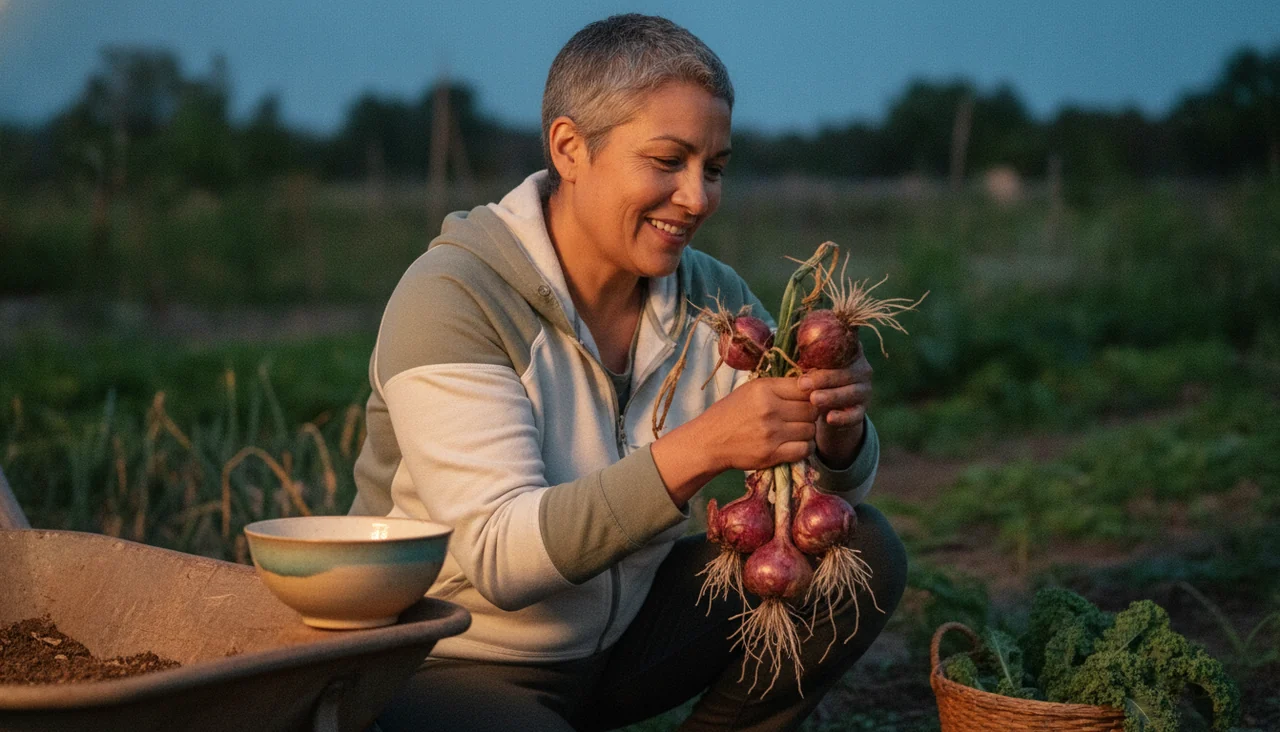
Quercetin is one of the most common dietary flavonoids. It occurs mainly in onions, apples, kale, and tea, usually attached to a sugar molecule (Almeida et al., 2018). A typical Western diet supplies an estimated 4 to 40 mg daily, mostly from onions (NIDDK, NCBI Bookshelf LiverTox, 2020). Berries and apple peels are also notably rich.
How it works
Picture quercetin as a letter mailed without a stamp — it rarely clears the first checkpoint unchanged. Most dietary quercetin is poorly absorbed, and what little gets through is quickly reshaped through conjugation (in plain English: chemically tagging a compound). That includes glucuronidation (in plain English: tagging a compound so the body can clear it), in the intestine and liver (Almeida et al., 2018). What shows up in blood is mostly metabolites (in plain English: breakdown products of the body's processing), not quercetin.
Who asks about it
People usually ask about quercetin after seeing it marketed for allergies. Others meet it through senolytic (in plain English: studied for clearing aging "zombie" cells) research.
What the research says
Of the conjugated quercetin metabolites measured in plasma, 78% to 79% were quercetin conjugates, with tamarixetin and isorhamnetin conjugates making up the rest (Almeida et al., 2018). NCCIH lists quercetin among options studied for allergic rhinitis, and evidence remains too limited to show benefit (NCCIH, 2019). Lab and animal studies describe antioxidant and anti-inflammatory activity, but human trials proving benefit are still lacking (NIDDK, NCBI Bookshelf LiverTox, 2020).
What to know before considering it
Quercetin supplements are sold in doses of 500 to 1,000 mg daily, well above dietary intake, and are not FDA-approved (NIDDK, NCBI Bookshelf LiverTox, 2020). Bioavailability also varies by person, shaped by gut bacteria and genetics. Anyone on prescription medication should check with a clinician first.
The Halftime POV
We think quercetin is a good example of chemistry that has outpaced its evidence. The food sources and metabolism are well documented; human data on aging is still thin. Halftime Health does not offer a quercetin protocol today, and we'd rather say so than round up marketing claims.
Related reading:
- Fisetin: the senolytic flavonoid
- Resveratrol and sirtuins: the research so far
- Ergothioneine: the longevity antioxidant
FAQ
Q: what foods are high in quercetin A: Onions, apples, kale, and tea are among the richest food sources of quercetin, a flavonoid compound found throughout the plant kingdom (Almeida et al., Comprehensive Reviews in Food Science and Food Safety, 2018). A typical Western diet supplies an estimated 4 to 40 mg of quercetin daily (NIDDK, NCBI Bookshelf LiverTox, 2020). Onions carry some of the highest concentrations of any common food.
Q: why does quercetin have low bioavailability A: Quercetin from food is poorly absorbed. Most of what does cross into the body is rapidly conjugated in the intestine and liver, meaning it gets chemically tagged with sugar-acid or sulfate groups (Almeida et al., Comprehensive Reviews in Food Science and Food Safety, 2018). Of the conjugated metabolites measured in plasma, 78% to 79% were quercetin conjugates, with tamarixetin and isorhamnetin conjugates making up the rest (Almeida et al., 2018).
Q: does quercetin work as a supplement A: The human evidence is limited. NCCIH lists quercetin among the nutritional approaches studied for allergic rhinitis and states the evidence is inconsistent or too limited to show benefit (NCCIH, 2019). Lab and animal research describes antioxidant and anti-inflammatory activity. That activity has not been shown effective in clinical trials for any medical condition, and quercetin supplements are not FDA-approved (NIDDK, NCBI Bookshelf LiverTox, 2020).
Disclaimer
This article is educational and is not medical advice. Compounded medications are not FDA-approved. Clinical outcomes depend on individual factors and require physician evaluation. Results vary.
Get started
We share what we learn along the way — the research, the regulations, the real-world trade-offs. Get started with Halftime Health.
Sources
- Quercetin — LiverTox, NCBI Bookshelf, NIDDK, NIH, 2020
- Seasonal Allergies at a Glance — NCCIH, NIH, 2019
- Almeida AF et al., "Bioavailability of Quercetin in Humans with a Focus on Interindividual Variation" — Comprehensive Reviews in Food Science and Food Safety, 2018
Frequently asked questions
what foods are high in quercetin
Onions, apples, kale, and tea are among the richest food sources of quercetin, a flavonoid compound found throughout the plant kingdom (Almeida et al., Comprehensive Reviews in Food Science and Food Safety, 2018). A typical Western diet supplies an estimated 4 to 40 mg of quercetin daily (NIDDK, NCBI Bookshelf LiverTox, 2020). Onions carry some of the highest concentrations of any common food.
why does quercetin have low bioavailability
Quercetin from food is poorly absorbed. Most of what does cross into the body is rapidly conjugated in the intestine and liver, meaning it gets chemically tagged with sugar-acid or sulfate groups (Almeida et al., Comprehensive Reviews in Food Science and Food Safety, 2018). Of the conjugated metabolites measured in plasma, 78% to 79% were quercetin conjugates, with tamarixetin and isorhamnetin conjugates making up the rest (Almeida et al., 2018).
does quercetin work as a supplement
The human evidence is limited. NCCIH lists quercetin among the nutritional approaches studied for allergic rhinitis and states the evidence is inconsistent or too limited to show benefit (NCCIH, 2019). Lab and animal research describes antioxidant and anti-inflammatory activity. That activity has not been shown effective in clinical trials for any medical condition, and quercetin supplements are not FDA-approved (NIDDK, NCBI Bookshelf LiverTox, 2020).
Keep reading


For living longer, and still feeling like yourself. It starts with your labs.
Membership from $39/mo, or $390 for the year, including your onboarding panel. Each protocol is its own monthly subscription.