
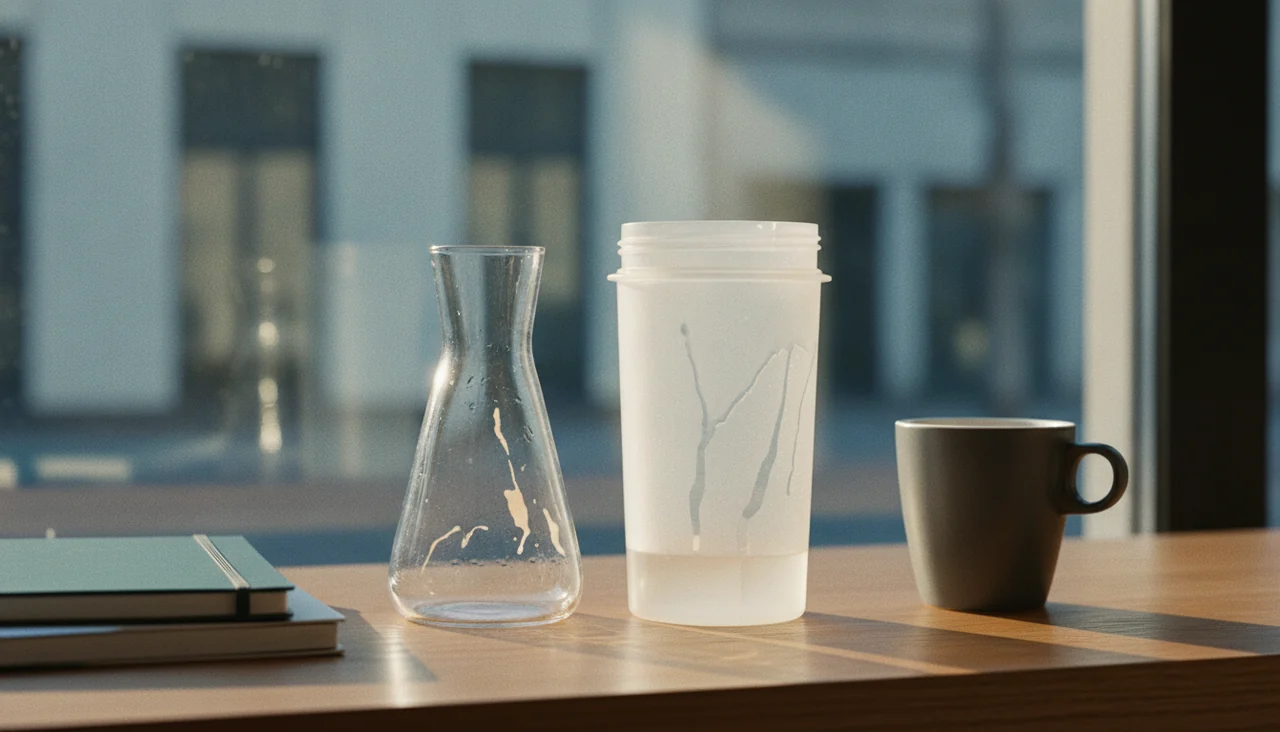
Surface Adsorption: Why Peptides Stick to Glass and Plastic
A dose can look correct on paper and still lose strength to the container walls it sat in.
TL;DR
- Surface adsorption is when peptide molecules stick to glass or plastic surfaces, pulling them out of solution.
- It matters most at low concentrations, where a fixed surface area strips away a large dose share.
- Formulators counter it with surfactants, carrier proteins, and low-bind containers, not by changing the peptide itself.
What surface adsorption is
Surface adsorption (in plain English: molecules sticking to a solid surface instead of staying dissolved) happens when a peptide's chemical groups grab onto glass or plastic. Borosilicate glass (in plain English: chemically resistant lab-grade glass used in vials) carries a charge that attracts peptide. Polypropylene (in plain English: a common plastic used for tubes and syringes) works differently but has the same effect. Either surface can pull peptide out of solution before a dose reaches a patient.
How surface adsorption works
Picture a peptide solution as a shallow pool and the container wall as flypaper. At high concentrations, only a thin layer near the wall touches it, so the loss barely registers. At low concentrations, that same wall has far more surface area per peptide molecule, so it strips away much more. The wall does not know how concentrated the solution is—it binds whatever touches first.
Who asks about surface adsorption
People ask about surface adsorption when a reconstituted peptide seems weaker than expected, or a dose behaves inconsistently. The real issue is usually container material and dilution, not peptide strength.
What the research says about surface adsorption
At typical experimental concentrations, 90 percent or more of a cationic peptide can be lost to glass and plastic surfaces (Kristensen, Henriksen, and Andresen, PLOS ONE, 2015). A similar pattern shows up with insulin. In one study, a 0.1-unit-per-mL solution retained only about 82 percent of its strength after polypropylene intravenous (IV) tubing. A 10-unit-per-mL solution retained close to 100 percent (Thompson, Vital-Carona, and Faustino, Diabetes Technology & Therapeutics, 2012). Dilute solutions lose proportionally more to container walls than concentrated ones.
What to know before considering peptide therapy
Surface adsorption is a handling and formulation problem, not a sign a peptide molecule is weak or defective. Formulators reduce it with a surfactant (in plain English: an additive that coats surfaces) such as polysorbate 80. Others add a carrier protein like albumin, or use a siliconized vial (in plain English: a silicone-coated container). Peptide access still requires a licensed clinician working with a pharmacy that manages these details.
The Halftime POV
We think surface adsorption shows why formulation quality matters as much as the peptide itself. A well-designed vial protects the dose you are paying for. Halftime works with pharmacy partners who account for this in packaging and dispensing.
Related reading:
- Peptide aggregation: why peptides clump together in solution.
- Isoelectric point: how it affects peptide solubility.
- What is an excipient: the ingredients that aren't the peptide.
- Water for injection grades: what reconstitution water needs.
FAQ
Q: what is surface adsorption A: Surface adsorption is when peptide molecules stick to the walls of glass or plastic containers instead of staying fully dissolved in solution. This pulls active peptide out of the liquid before it can be measured or dosed accurately. It is a physical sticking effect caused by the container, not a change in the peptide's chemical structure.
Q: why do peptides stick to glass vials A: Peptides carry charged and non-polar chemical patches that can grab onto a glass surface, especially borosilicate glass commonly used in vials. The container wall does not distinguish between peptide types; it simply binds whatever touches it first. This effect is usually strongest right after a peptide is reconstituted, before the solution settles.
Q: does surface adsorption affect peptide dosing A: Yes, surface adsorption can affect peptide dosing because a fixed amount of container surface removes a larger share of a dilute dose than a concentrated one. A low-concentration vial can lose a meaningful fraction of its peptide to the container walls before it is ever drawn up. A licensed clinician and pharmacy account for this when a formulation is designed.
Q: how do formulators prevent peptide adsorption to plastic A: Formulators prevent peptide adsorption to plastic by adding a surfactant such as polysorbate 80, which coats the container wall so peptide molecules have nothing to stick to. Some formulations add a carrier protein like albumin, or switch to a siliconized or low-bind container. These choices are made well before a product ever reaches a patient.
Disclaimer
This article is educational and is not medical advice. Compounded medications are not FDA-approved. Clinical outcomes depend on individual factors and require physician evaluation. Results vary.
Get started
We share what we learn along the way — the research, the regulations, the real-world trade-offs. Get started with Halftime Health.
Sources
- Adsorption of Cationic Peptides to Solid Surfaces of Glass and Plastic — PLOS ONE, 2015
- The Effect of Tubing Dwell Time on Insulin Adsorption During Intravenous Insulin Infusions — Diabetes Technology & Therapeutics, 2012
Frequently asked questions
what is surface adsorption
Surface adsorption is when peptide molecules stick to the walls of glass or plastic containers instead of staying fully dissolved in solution. This pulls active peptide out of the liquid before it can be measured or dosed accurately. It is a physical sticking effect caused by the container, not a change in the peptide's chemical structure.
why do peptides stick to glass vials
Peptides carry charged and non-polar chemical patches that can grab onto a glass surface, especially borosilicate glass commonly used in vials. The container wall does not distinguish between peptide types; it simply binds whatever touches it first. This effect is usually strongest right after a peptide is reconstituted, before the solution settles.
does surface adsorption affect peptide dosing
Yes, surface adsorption can affect peptide dosing because a fixed amount of container surface removes a larger share of a dilute dose than a concentrated one. A low-concentration vial can lose a meaningful fraction of its peptide to the container walls before it is ever drawn up. A licensed clinician and pharmacy account for this when a formulation is designed.
how do formulators prevent peptide adsorption to plastic
Formulators prevent peptide adsorption to plastic by adding a surfactant such as polysorbate 80, which coats the container wall so peptide molecules have nothing to stick to. Some formulations add a carrier protein like albumin, or switch to a siliconized or low-bind container. These choices are made well before a product ever reaches a patient.
Keep reading




Buying peptides online? There is a route with labs first and a licensed physician.
Membership from $39/mo, or $390 for the year, including your onboarding panel. Each protocol is its own monthly subscription.