
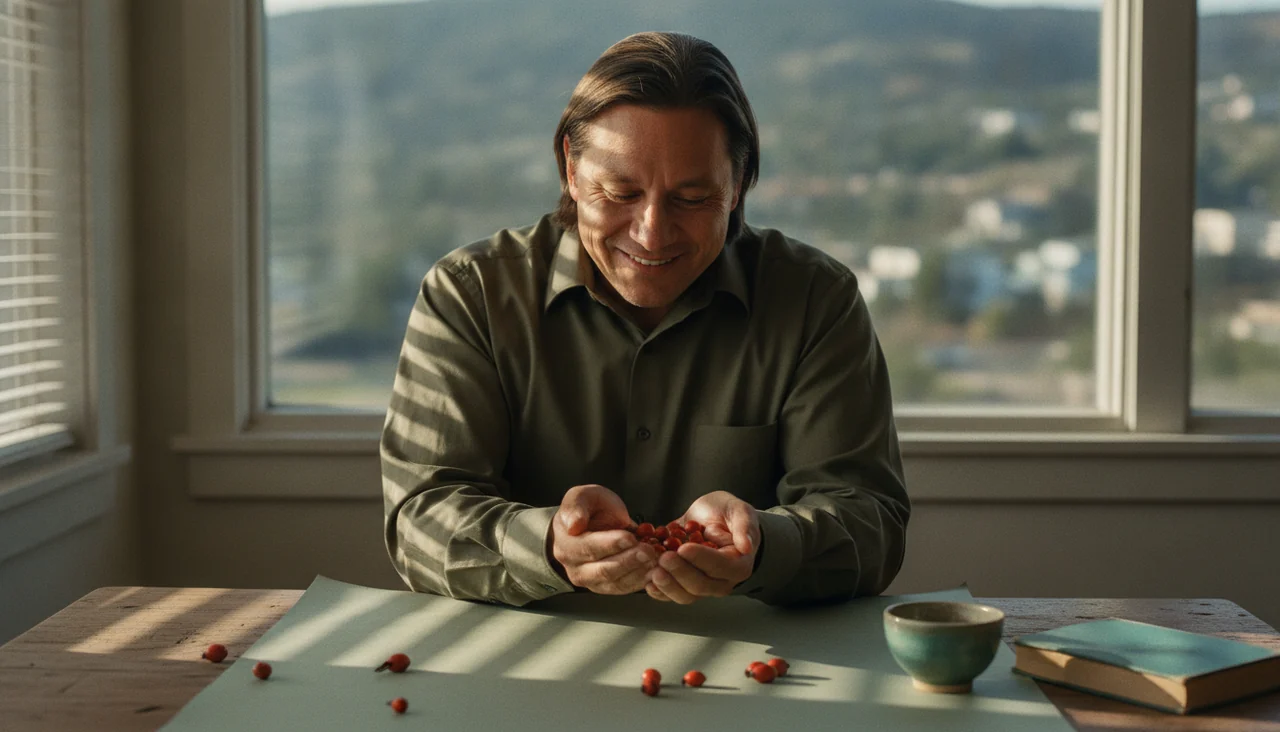
Astaxanthin and aging: what the research shows
A red pigment from algae with an unusually elegant membrane trick, and human evidence that is still catching up to the chemistry.
TL;DR
- Astaxanthin is a red-orange carotenoid pigment made by algae, the same source that colors salmon and shrimp.
- Its molecular shape lets it span a full cell membrane instead of sitting on one side.
- Human research is real but small, mostly short trials on skin and eye-related measures.
What is astaxanthin, really?
Astaxanthin (in plain English: a red-orange pigment) is a carotenoid that certain microalgae produce, most notably Haematococcus pluvialis (in plain English: a freshwater algae species) (Peana et al., Molecules, 2022). Salmon, shrimp, and lobster get their reddish color from eating this algae, or from eating something else that did. Chemically, it is a xanthophyll (in plain English: an oxygen-containing carotenoid), a cousin of beta-carotene rather than the same molecule.
How it works
Picture a foam mattress with a long steel rod running through it, end to end. Most carotenoids sit on one side of a cell membrane, the way a small magnet clings to one face of a fridge door. Astaxanthin's elongated shape lets it span the full width instead (Peana et al., Molecules, 2022). Researchers describe that position as letting it intercept damage-causing molecules on both membrane surfaces at once, not just one.
Who asks about it
People ask about astaxanthin after spotting it in skincare or eye-strain supplements, curious what a fish-feed pigment has to do with aging.
What the research says
Human research on astaxanthin is real but small. In a 10-week randomized, placebo-controlled trial, 23 healthy adults took 4 mg of astaxanthin daily. The astaxanthin group tolerated more UV exposure before reddening and lost less skin moisture than placebo (Ito et al., Nutrients, 2018). A 2022 review describes further small trials on skin texture alongside lab work on oxidative stress pathways, while noting that deeper mechanistic understanding is still needed (Peana et al., Molecules, 2022). No large randomized trial has tested astaxanthin against a hard endpoint like mortality.
What to know before considering it
Astaxanthin supplements are not reviewed by the FDA for effectiveness before reaching shelves. The trials that exist are short, involving dozens of participants rather than thousands. Anyone on blood-thinning medication, or who is pregnant, should check with a clinician before adding a new supplement.
The Halftime POV
We find the membrane chemistry genuinely interesting and the human evidence genuinely early. Astaxanthin's molecular shape is a well-described structural story. Longevity claims sometimes built on top of it are ahead of what small trials have actually shown.
Related reading:
- Vitamin E tocotrienols and aging
- Alpha-lipoic acid and aging
- Ergothioneine, the longevity antioxidant
FAQ
Q: what is astaxanthin A: Astaxanthin is a red-orange carotenoid pigment made by microalgae, most notably Haematococcus pluvialis. Salmon, shrimp, and lobster get their color from eating this algae or organisms further up the food chain that did (Peana et al., Molecules, 2022). It is chemically a xanthophyll, a cousin of beta-carotene rather than the same molecule.
Q: does astaxanthin help skin aging A: Early evidence is suggestive but limited. In a 10-week trial, 23 adults taking 4 mg of astaxanthin daily showed a higher tolerance to UV-induced redness and less UV-related skin moisture loss than placebo (Ito et al., Nutrients, 2018). That is one small trial, not proof the pigment slows visible skin aging broadly.
Q: is astaxanthin backed by human research A: Some human research exists, but it is mostly small trials focused on skin and eye-related measures rather than large studies on longevity outcomes (Peana et al., Molecules, 2022). No large randomized trial has tested astaxanthin against a hard endpoint like mortality or major disease, so the evidence base is real but early.
Disclaimer
This article is educational and is not medical advice. Compounded medications are not FDA-approved. Clinical outcomes depend on individual factors and require physician evaluation. Results vary.
Get started
We share what we learn along the way — the research, the regulations, the real-world trade-offs. Get started with Halftime Health.
Sources
Frequently asked questions
what is astaxanthin
Astaxanthin is a red-orange carotenoid pigment made by microalgae, most notably Haematococcus pluvialis. Salmon, shrimp, and lobster get their color from eating this algae or organisms further up the food chain that did (Peana et al., Molecules, 2022). It is chemically a xanthophyll, a cousin of beta-carotene rather than the same molecule.
does astaxanthin help skin aging
Early evidence is suggestive but limited. In a 10-week trial, 23 adults taking 4 mg of astaxanthin daily showed a higher tolerance to UV-induced redness and less UV-related skin moisture loss than placebo (Ito et al., Nutrients, 2018). That is one small trial, not proof the pigment slows visible skin aging broadly.
is astaxanthin backed by human research
Some human research exists, but it is mostly small trials focused on skin and eye-related measures rather than large studies on longevity outcomes (Peana et al., Molecules, 2022). No large randomized trial has tested astaxanthin against a hard endpoint like mortality or major disease, so the evidence base is real but early.
Keep reading

For living longer, and still feeling like yourself. It starts with your labs.
Membership from $39/mo, or $390 for the year, including your onboarding panel. Each protocol is its own monthly subscription.